Paul Rayley
To the LighthousePaul Rayley’s story moves from uncertain courtship to engagement and then, in Lily Briscoe’s later recollections, to a marriage altered by strain and accommodation. Initially treated as a good-natured but not especially brilliant young man, he is nevertheless capable of decisive action: encouraged by Mrs Ramsay’s confidence in him, he asks Minta Doyle to marry him. Their engagement promises a future together, but it does not guarantee that their marriage will remain happy or unchanged.
Identity and Introduction
Paul is one of the young visitors staying with the Ramsays, and his presence is connected from the outset with Minta Doyle. Mrs Ramsay notices that the two have gone walking after lunch and reasons that their absence means Minta must either accept or reject him. She favors Paul, whom she regards as a good fellow, and privately prefers his unpretentiousness to the cleverness of men such as Charles Tansley. Her expectation that Minta will accept him is an inference, not yet a confirmed fact; at that point she is still waiting to hear what has happened.
Paul’s character is presented less through a formal description than through the way he attends to others and imagines what he might become. During a conversation about books, he recalls reading Tolstoy at school and remembers the name Vronsky because he thought it suited a villain. When Mrs Ramsay declines a pear, he considers whether she might be cold, feel a draught, or want some fruit. She finds this modest attentiveness attractive: his attention seems directed outward, toward her comfort, rather than toward making an impression. That consideration sits alongside his capacity for nervous self-consciousness, which becomes especially clear when he reflects on his proposal to Minta.
Courtship and Engagement
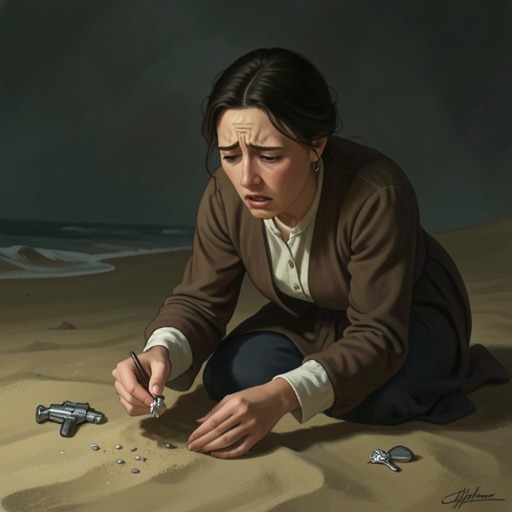
On the walk, Paul and Minta are found kissing behind a rock by Nancy, who has run up the beach with Andrew. Nancy and Andrew respond with silence and irritation, and the scene leaves them feeling that the awkward encounter was not their fault. The moment is followed by a practical misfortune: Minta discovers that she has lost her grandmother’s brooch, a willow-shaped ornament that was her only piece of jewelry and had been fastened to her grandmother’s cap until the end of her life.
The rising tide makes an immediate search seem futile. Paul searches urgently around the rock, but the party cannot keep looking as the water advances. He and Andrew decide to mark the place with Paul’s stick and return at low tide; Paul assures Minta that the brooch may still be there in the morning. As he walks with her afterward, he tells her that he has a reputation for finding things and recalls once finding a gold watch as a boy. He privately plans to rise at dawn to search for the brooch without telling her. If it is gone, he considers going to Edinburgh to buy her a replacement that is more beautiful. His secret plan turns the search into a test of what he can do for her, though the evidence does not establish whether he finds the original brooch or carries out the purchase.
As they return toward the house, Paul imagines marriage, children, and a home, and pictures himself leading Minta as they withdraw together into solitude. Yet the proposal itself has been frightening for him. He thinks it was the worst moment of his life to ask her to marry him, and he wants to tell Mrs Ramsay what he has done because she has made him believe he could do anything. He credits her unspoken confidence: throughout the day, he has felt that her attention conveyed belief in him and an expectation that he would act. In his mind, he means to thank her for making the proposal possible.
Mrs Ramsay’s response when she learns that Paul has a watch completes this exchange of confidence. As she comes downstairs, she readily encourages the young people to go to the beach to watch the waves, laughing and helping Minta with her wrap. Minta says that Paul has a watch, and he takes a beautiful gold one from a small wash-leather case to show Mrs Ramsay. Though he does not need to explain himself, he feels that she understands that he has proposed and that he owes the achievement to her. Mrs Ramsay, seeing the watch in his hand, thinks Minta fortunate to be marrying a man who keeps such an object in a wash-leather bag. Her warmth makes the engagement feel recognized within the household, even as she herself cannot join the young people on their outing.
Marriage and Later Recollections
The later account of Paul and Minta comes through Lily’s retrospective imagination, which the novel explicitly marks as uncertain. Lily gathers impressions of the Rayleys and turns them into scenes, but recognizes that some of what she pictures is invented rather than known. The distinction matters: the narrative gives evidence of a troubled marriage, while also showing how little Lily can claim to know about another couple’s private life.
One scene Lily imagines takes place on a staircase around three in the morning. Minta, dressed conspicuously, is eating a sandwich near a window; Paul comes out in pajamas with a poker, apparently prepared for a possible burglar. Lily imagines him speaking angrily in a low voice so as not to wake their two young sons, while Minta continues eating. From these scenes she concludes that the marriage has gone badly after its first year or so. She also recalls Paul saying that he played chess in coffeehouses, and imagines him staying out while Minta is away, then returning to a strained home. These details are presented as Lily’s constructions, not as verified reports of conversations or events.
Lily does recall visiting the Rayleys at a cottage near Rickmansworth, where the atmosphere seemed painfully strained. Paul took her to see the Belgian hares he bred, while Minta followed and sang. Lily interprets Minta’s gesture of putting her bare arm on Paul’s shoulder as an attempt to prevent him from telling her something. The visit gives her a concrete impression of tension, but her account remains an observer’s reading of gestures rather than access to either spouse’s full perspective.
By a later summer, Lily judges that the Rayleys have passed through a dangerous period. When their car breaks down, Paul sits by the road repairing it and Minta hands him the tools in a businesslike, friendly way. For Lily, this ordinary cooperation is evidence that the marriage has steadied. She thinks they are no longer in love in the earlier romantic sense, and that Paul has taken up with another woman, described as serious and aligned with his increasingly pronounced political views on land-value taxation and a capital levy. Rather than breaking up the marriage, this alliance appears, in Lily’s account, to have helped right it: Paul and Minta have become excellent friends.
Relationships and Narrative Significance
Paul’s relationship with Mrs Ramsay is important because her belief in him helps him cross the distance between imagining a future and proposing marriage. He sees her as someone who takes him seriously when others do not, and he intends to acknowledge her part in his decision. Mrs Ramsay’s support is not represented as control over his choice; rather, her confidence gives him a sense of possibility at a moment when action feels overwhelming. Her favorable view of Paul also shapes how she interprets his attentions and the couple’s engagement.
Paul and Minta’s relationship is presented in distinct phases: a courtship that Mrs Ramsay anticipates with sympathy, a proposal Paul experiences as frightening, an engagement marked by his private plans to recover or replace Minta’s lost brooch, and a later marriage that Lily sees as troubled before it becomes more companionable. The brooch episode gives the courtship a material focus: Minta’s grief concerns an heirloom tied to her grandmother, while Paul responds by promising a search and privately imagining a replacement. The episode does not resolve the loss, but it reveals how each responds to the other—Minta’s attachment to the object and Paul’s desire to prove his resourcefulness.
The contrast between Paul’s early visions and Lily’s later account prevents the engagement from serving as a simple guarantee of romantic fulfillment. On the walk home, he imagines children and a shared life; years later, Lily pictures children already in the strained household and sees the spouses no longer bound by the same romantic intensity. Yet the final image of the stopped car offers neither uncomplicated happiness nor complete separation. The tools pass between them, and their practical cooperation suggests a durable friendship. Paul’s trajectory thus makes the novel’s treatment of marriage provisional: a proposal can open a future, but the relationship that follows can change its form without simply ending.